A Trusted Learning and Development Advisor
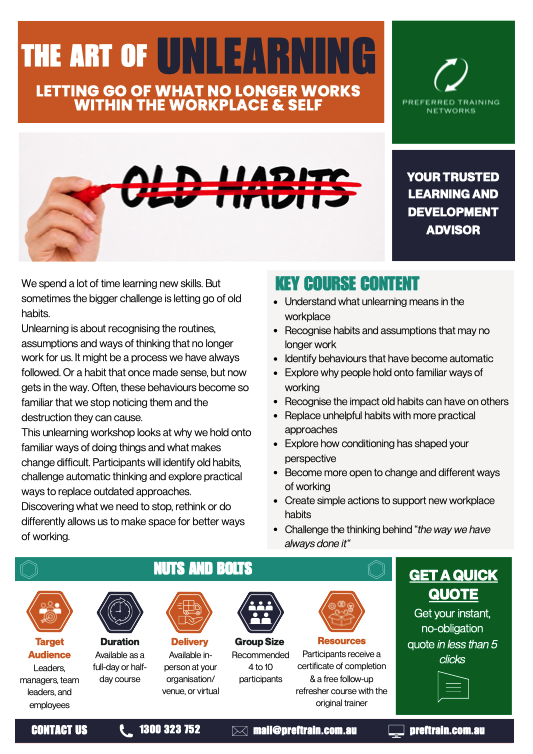
We spend a great deal of time learning new skills, but sometimes progress depends on recognising what we need to stop doing. The Unlearning at Work Training Course helps participants identify outdated habits, assumptions, and automatic behaviours that may once have been useful but are now getting in the way of better performance, collaboration, and change.
Unlearning at work does not mean forgetting everything you already know. It means becoming aware of routines, behaviours, and ways of thinking that are no longer helpful, then making a conscious decision to replace them with more effective approaches.
Some workplace habits become so familiar that people stop questioning them. A process may continue simply because “this is how we have always done it”. An employee may respond to situations automatically because that behaviour has been reinforced over many years. This workshop helps participants pause, reconsider these patterns, and make room for better ways of working.
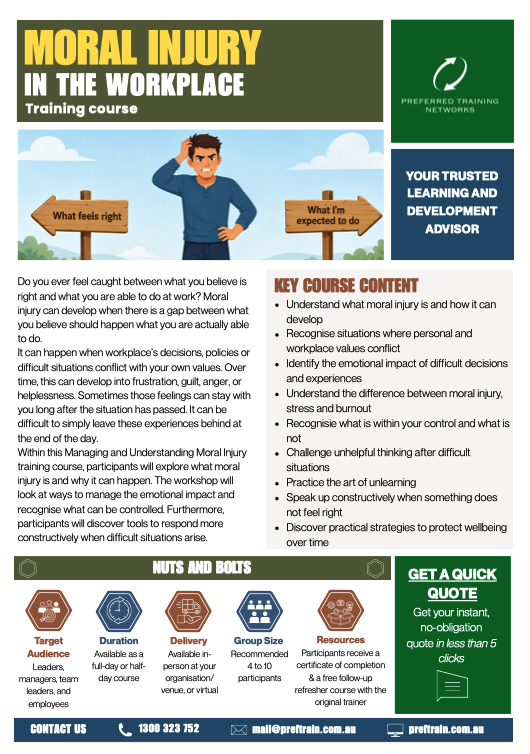
Sometimes the hardest workplace experiences are not about workload or pressure. They happen when people feel they are being asked to act in ways that conflict with what they believe is right. Moral Injury in the Workplace can develop when there is a gap between personal values and what an employee is able, expected, or required to do.
Moral injury can arise when workplace decisions, policies, or difficult situations challenge a person’s values. Over time, this can contribute to feelings such as frustration, guilt, anger, or helplessness. These reactions can stay with people long after the original situation has passed, particularly when they feel they had limited control over the outcome.
This course helps participants understand what moral injury is, how it differs from stress and burnout, and why it can develop in workplace settings. The focus is on recognising what is within an individual’s control, challenging unhelpful thinking, and developing practical ways to respond more constructively when difficult situations arise.
Resilience is not a fixed personality trait. It is a set of skills and habits that can be learned, practised and strengthened over time. The challenge for most organisations is that resilience is rarely taught in any structured way, leaving staff to develop coping strategies on their own, often through trial and error.
This workshop changes that. Participants leave with a concrete personal toolkit they can draw on immediately, as well as a shared language for discussing stress, pressure and wellbeing across their team.
Organisations that invest in resilience training also report broader benefits. When staff are better equipped to manage pressure, they recover more quickly from challenging interactions, maintain higher performance under difficult conditions, take fewer stress-related absences and contribute to a more stable and supportive team culture. This connects directly to stronger overall workplace performance.
For teams navigating significant organisational change, pairing this course with our change management programs creates a powerful combination that addresses both the practical and emotional dimensions of transition.
Related courses:
Related courses:
Related courses:
Related courses:
Related courses:
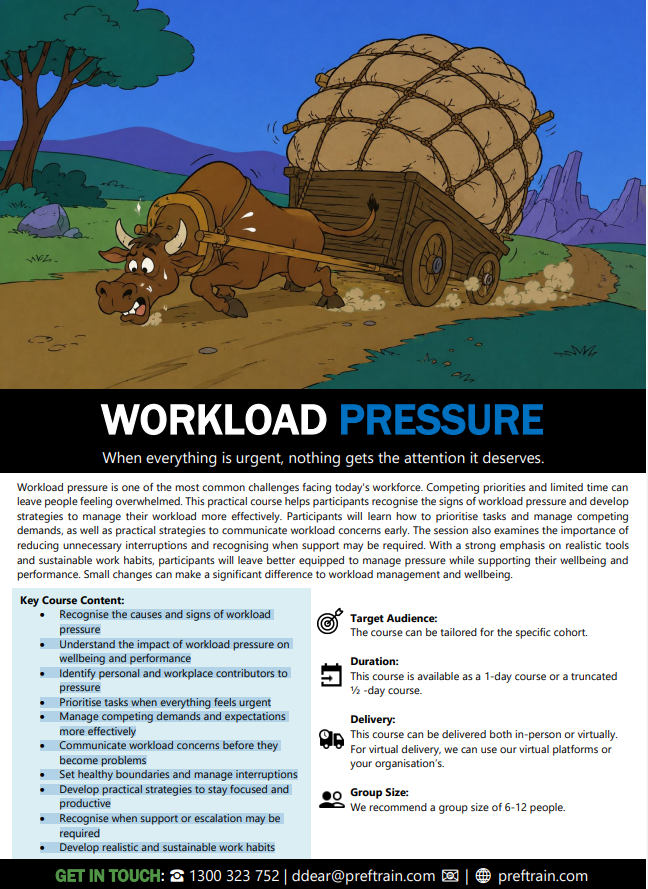
Modern workplaces require more than just effort. They require clarity, structure, and the ability to manage competing priorities without losing control. When capability is not well developed, teams can become reactive, overwhelmed, and inconsistent in their performance.
The Workplace Capability Training course by Preferred Training Networks helps participants develop practical systems to stay organised, manage workload effectively, and improve follow through. This hands on workshop focuses on building sustainable work habits that support consistent performance across both physical and virtual environments.
This workplace bullying course is a good opportunity to quickly revisit your bullying policy and procedures. Imagine the difference if you removed all bullying allegations from your workplace. Our course enables participants to effectively deal with workplace bullying.
“Inwardly they are hoping the situation will sort itself out — it almost never does.”
Nuts and Bolts
Would you like to attend this program?
Wondering how to deal with a bully? Our course is ideal for you.
Suitable for anyone who has been asked to take up the role of a mentor, our mentoring training course equips people with outstanding skills. Learn how to establish a meaningful mentoring relationship with our mentor training course.
For maximum effectiveness, this program is best conducted as an in-house program.
Venue: For your convenience, you can choose to conduct this program at your workplace. Alternatively, we can provide a training venue at a small additional cost.
Target Audience: Mentors
Cost: Price on request.
If you would like more information on this training program, please contact:
Preferred Training Networks on 1300 323 752
Email: Deborah [email protected]
or visit our website today: www.preftrain.com
The Manager’s Guide to Reducing Workplace Sickies
Although sickies are often joked about as being an Australian institution, they cost Australia billions of dollars every year. Of course, sick days are inevitable but some sickies are signs of despair and some sickies are discretionary.
Every manager who attends this breakthrough program receives a “managing workplace sickies workbook” written by a psychologist to help reduce the amount of sickies in your organisation.
Signposts of Sickies:
Sick of self
From time to time, people feel low esteem. Self motivation ebbs and tasks become chores. When people are sick of themselves they often feel more isolated and find it difficult to get back on track.
Sick of colleagues and people
You might notice that some of your people are not themselves. They just don’t seem to care about their colleagues. They become indifferent and often focus more on the process than the person.
Sick of work
This is the number #1 cause of discretionary sick days in the workplace. The employee is sick of the workplace. When that alarm goes off in the morning, they groan and look for options to take a sickie. These employees often have a hostage mentality and they are disengaged from your organisation.
Sick of Pressure
Throughout our working lives, we face constant hurdles and struggle points. Occasionally, employees reach crisis points and either bottle up the pressure or explode. Learn proven methods to regulate and release the levels of stress and anxiety in the workplace.
Sick Sick
When you’re sick, you’re sick. That is why the sick days are there. Usually you don’t want sick people in the workplace, and you would much prefer them at home resting and recuperating. However, in this session participants learn ways to avoid and reduce the amount of bacterial based germs in the workplace. And you also learn some ideas on how to keep employees fit and healthy.
Maintaining a fit and healthy workforce – what can you do?
4 Benefits of running this course
THE NUTS AND BOLTS
This program can be conducted as in-house training on site anywhere in Australia.
GUIDELINES
Group Size: An ideal group size is 4?–12 participants.
Venue: For your convenience, you can choose to conduct this program at your offices. Alternatively, we can provide a training venue at a small additional cost
Duration: This program is conducted as a one day course.
Cost: Upon request.
Target Audience: Senior management, middle management, team leaders and supervisors.
This program will provide your staff with a range of skills and knowledge to better manage and address poor performance. Drawing on current data and using a very practical approach, this program will give your managers the confidence to better manage performance and work towards improved outcomes and productivity. Equip your team with real-world tools to lift accountability, tackle underperformance, and align expectations.
*** Please note, we can incorporate your performance management policy and procedure and any other relevant organisational information into the program.***
Group Size: An ideal group size is 6 – 10 participants. “Tailored for Fair Work and current HR frameworks”
Venue: For your convenience, you can choose to conduct this program at your offices. Alternatively, we can provide a venue at a small additional cost.
Duration: This course can be adapted to fit with your timeframe.
Cost: Upon request.
Target Audience: Managers, Team Leaders and Supervisors
How good are your trust building skills?
For maximum effectiveness, this program is best conducted as an in-house program.
If you would like more information on this training program, please contact: Deborah Dear on 1300 323 752 or email: [email protected] or contact us online today.
 Posted on Google
Trustindex verifies that the original source of the review is Google.
The course was very informative and it presented exceptionally well!Kelvin Muchiri Posted on GoogleReally found inspiration and hope in what Michelle providedRhonda Rees
 Posted on GoogleAmazing course! Engaging, fun and learnt so much. Thank you always.Kate Bartlett
 Posted on GoogleTom was a fabulous trainer very knowledgeable and able to provide practical real life examples and tools that will prove extremely useful.Vicki Hutchinson
 Posted on GoogleBest every courseYonas Masrsha Tesfaye
 Posted on GoogleDr Marny Lishman crated an amazing space that not only was open, safe and caring, but gave insight into many different aspects of resilience. She apprieciated different perspectives and opened discussions that were supported and wise. The presentation was targeted and had the perfect balance of knowledge and reflection. I would encourage this workshop for any team, especially those preparing of have gone through organisational change!Ethan Calleja
 Posted on GoogleDid this course in a session at Professional Services Review Training .Very helpful especially in my work in Public Health .Lots of useful ‘tips and tricks ‘Nedra Vanden Driesen